A lot of my beloved television shows used to be literary assets. By now, it’s a cliché to point out how often great television shows are based on books. Below, you will find 10 of my best small-screen adaptations of literary works.
I’ve surely forgotten many great shows, and I’m sure you will discuss the best literary adaptations in the comments.
10. The Leftovers
HBO (June 2014 – June 2017)
Based on the novel by American author Tom Perrotta the show chronicles life on earth after a rapture-like event that takes some and leaves others behind. The Leftovers was good when it was adhering to the source material, but great when it shook loose from it. The first season is more or less the novel, but after that, it’s all made up and blurs the line between adaptation and simple progression of the novel in a different interpretation. Despite this, the show is excellent, taking on the biggest questions of survival in a way that stays ambitious, entertaining, and deftly told.
9. I, Claudius
BBC (1976)
A 13-part series based on Robert Graves’ novels, centering on the historian Claudius and how, in an unlikely and violent chain of events, he came to rule the Roman Empire. It’s dated, to be sure, but it’s also excellent, and it set the stage for countless sweeping historical family and crime dramas with higher production values. But even without them, it’s iconic, engaging, and vivid television.
8. The Forsyte Saga
BBC2 (1967)
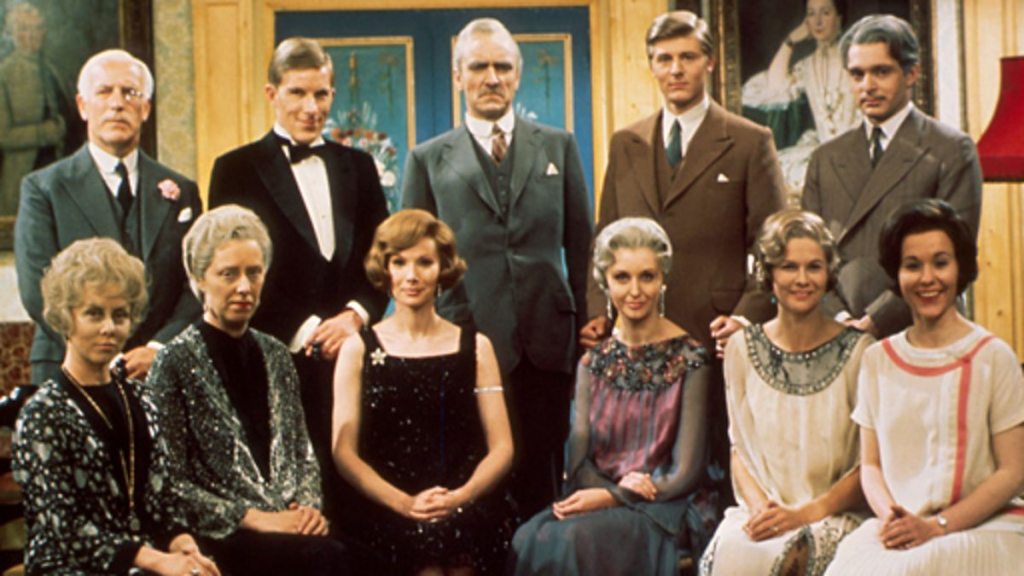
Based on the Nobel Prize-winning novels by John Galsworthy, The Forsyte Saga is an epic and highly praised series traversing three generations of the powerful Forsyte family at the turn of the 20th century. Beneath the family’s grand veneer lies a festering core of troubled and brutal relations. One of the last great shows to be broadcast in black and white. Even though the books won Galsworthy a Nobel Prize, this TV show is actually better than the books.
7. War & Peace
BBC (2016)
Andrew Davies’ adaptation of Tolstoy’s War and Peace, starring Lily James, Paul Dano and James Norton, will bring one of the greatest novels of all time to life on a truly grand scale. At the center of it all stands Pierre Bezukhov (Paul Dano), a hot-headed newcomer in Russian society. His sincere good nature is a comfort to his friend Andrei Bolkonsky (James Norton): a cynical prince who longs for glory on the field of battle. Both their fates are bound to the beautiful, captivating, kind-hearted Natasha Rostova (Lily James).
Over eight years of peace and war that will change Russia and its people forever, we meet a cast of unforgettable characters. Again and again, through marriages and affairs, battlefields and ballrooms, births and deaths, we return to Pierre, Andrei, and Natasha as they confront life’s great questions of love and destiny.
6. American Gods
Starz (2017)
American Gods is a Starz series adaption of the 2001 award-winning fantasy novel of the same name written by Neil Gaiman. The first season of American Gods debuted on Starz on April 30, 2017 looks great. Visually, it’s rich and sensual and weird—which often makes for captivating television. The second season debuted on Starz on March 10, 2019. The story is about a war brewing between Old Gods and New Gods. The traditional gods of mythological roots from around the world steadily losing believers to an upstart pantheon of gods reflecting society’s modern love of money, technology, media, celebrity, and drugs.
5. The Haunting of Hill House
Netflix (2018-present)
First published in 1959, Shirley Jackson’s The Haunting of Hill House has been hailed as a perfect work of unnerving terror. The greatest haunted house story ever written, the inspiration for a 10-part Netflix series directed by Mike Flanagan and starring Michiel Huisman, Carla Gugino, and Timothy Hutton. The show has very little to do with Jackson’s iconic novel, but that’s okay: it’s a family drama, part horror story, and definitely scary, if a little slow.
4. The Handmaid’s Tale
Hulu (2017)
The Handmaid’s Tale is an endlessly engrossing adaptation of Margaret Atwood’s dystopian novel that’s anchored by a terrific central performance from Elisabeth Moss.
Despite its creepy branding efforts and unnecessary second season, the first season of The Handmaid’s Tale is moving, chilling, and uncomfortably close to home. It also renewed everyone’s interest in the original novel, which has its upsides and downsides. But for the first season alone, it belongs on this list.
3. Sherlock
BBC (2010-2017)
The most recent adaptation of Sir Arthur Conan Doyle’s beloved stories may not be the purest version of Holmes but it makes for fine, entertaining television with witty writing, great acting, and enough attitude to poison a small village.
2. Beauty and the Beast
CBS (1987-1990)
Oh, it’s campy as all hell, but it’s pretty well written, and yes, that’s Rob Perlman and Linda Hamilton. And you know who liked it? Jack Zipes, fairy tale expert. “They’re on to something very significant,” Zipes told The New York Times. “They found the equivalents in contemporary society—the beast as an outcast who lives with the homeless. I think it’s a fascinating way to reinterpret a traditional fairy tale and make it very relevant concerning social and political problems, the homeless, outcasts. It has a nice sense of justice. But it’s a mixed bag. My complaint is that it also uses the worst aspects of criminal-adventure television.”
1. Pride and Prejudice
BBC (1995)
The BBC’s production of Pride & Prejudice is still popular and beloved to this day. Before the world was collectively falling under the spell of Downton Abbey, another mini-series had audiences swooning over period costumes, incontrovertible storytelling, and pithy dialogue. It was the 1995 BBC adaptation of Jane Austen’s Pride & Prejudice, about a headstrong country girl and the aloof aristocratic gentleman that falls in love with her.
It’s layered with social commentary about the role of women and marriage in the Regency era Britain and is slyly funny. It’s no wonder we can’t get enough of this book on screen.

 Cinema Nerd